It's All in the Temperature: The Forgotten Science That Separates Boiled Sweets from Barley Sugar
Pick up a lemon drop from a jar on the counter and a twist of barley sugar from the tin beside it. Hold one in each hand. They're both hard, both translucent, both made primarily from sugar. Pop them in your mouth one after the other, though, and you'll notice something's different. The lemon drop shatters cleanly. The barley sugar yields more slowly, with a faint graininess, a warmth, a chew that lingers just a beat longer than you'd expect. Most people shrug and reach for another one. But confectioners — the proper old-school kind — will tell you that difference is everything. It's the product of centuries of accumulated craft, and it's a lot more interesting than it sounds.
Sugar Is Not Just Sugar
Let's start at the very beginning, because the confusion between boiled sweets and barley sugar starts here. Both are made from sugar. Both involve boiling that sugar with water. Both cool into something solid and translucent. So far, so similar. But what happens during that boiling process, and what you do with the sugar immediately afterwards, determines whether you end up with something glassy and brittle or something with that distinctive, almost silky chew.
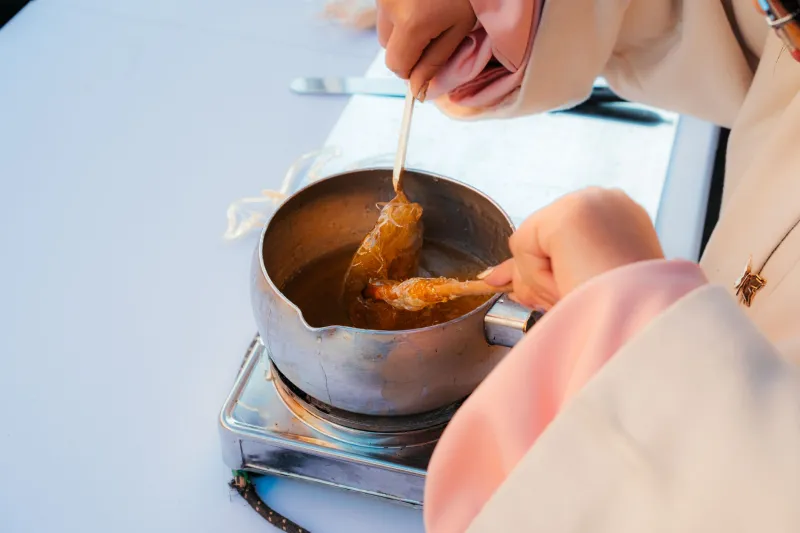
The key variable is temperature. When you dissolve sucrose in water and apply heat, the mixture passes through a series of distinct stages — soft ball, firm ball, hard ball, soft crack, hard crack — each corresponding to a precise temperature range and a specific water content in the syrup. Boiled sweets are cooked to the hard crack stage, somewhere between 149°C and 154°C. At that temperature, almost all the water has been driven off. What you're left with, once it cools, is an amorphous solid — technically a supercooled liquid — that's rigid, glassy, and snaps cleanly when bitten.
Barley sugar, despite its name and its ancient reputation, is a different beast entirely.
What Barley Sugar Actually Is (And Isn't)
Here's where it gets historically interesting. Traditional barley sugar was originally made by boiling sugar with a decoction of pearl barley — the starchy water left behind after cooking the grain. The barley water introduced impurities into the sugar syrup, and those impurities did something chemically significant: they interfered with the crystallisation process. This is what gave old-fashioned barley sugar its characteristic slightly amber colour, its gentle opacity, and that subtly grainy, almost fudge-adjacent texture.
Modern barley sugar rarely contains actual barley. What you'll find instead is a sweet that uses cream of tartar or glucose syrup as the 'doctor' — the confectioner's term for an ingredient that disrupts crystal formation. But the principle is the same. The goal is a sweet that sits in a slightly different structural state to a standard boiled sweet. Not fully amorphous, not fully crystalline, but somewhere in between. A little less glassy. A little more forgiving on the tooth.
The cooking temperature for barley sugar is also typically a few degrees lower than for a standard boiled sweet — closer to the soft crack stage than hard crack. That slight difference in residual moisture is enough to change the mouthfeel entirely.
The Cooling Slab: Where the Magic Actually Happens
If temperature is the first variable, cooling is the second — and arguably the one where a confectioner's skill really shows itself.
When boiled sweet syrup is poured onto a traditional marble or granite slab, it needs to cool quickly and evenly. The confectioner works it with a palette knife or scraper, folding it in on itself, managing the temperature drop so that it remains workable long enough to be pulled, twisted, or pressed into moulds. Work it too little and the sweet will be brittle and uneven. Work it too much and you introduce too many air bubbles, or worse, you encourage crystallisation where you don't want it.
With barley sugar, the working process is different. The twist — that iconic spiral shape you see in old-fashioned tins — isn't just decorative. It's a function of pulling the warm sugar at a specific temperature and twisting it before it sets. The twist actually affects how the sweet breaks down in the mouth. Those angled planes of sugar dissolve at slightly different rates, contributing to the layered sensation that barley sugar devotees describe as 'complex' and that everyone else just calls 'a bit chewy in a good way.'
Why Modern Sweet Lovers Can't Tell the Difference
Here's an uncomfortable truth: a lot of what's sold as barley sugar today is functionally indistinguishable from a basic boiled sweet. Industrial production methods have flattened out many of the differences. Mass-produced barley sugar is often made with glucose syrup as the sole 'doctor,' cooked at consistent temperatures in automated kettles, and cooled on conveyor systems that leave no room for the kind of hands-on working that creates genuine textural complexity.
It's not that these sweets are bad. They're not. But they're a standardised product, and standardisation is the enemy of the small, meaningful differences that make traditional confectionery genuinely worth thinking about.
The confectioners who still do it properly — and there are a few left, scattered across the country from Yorkshire to the Scottish Borders — will tell you they can taste the difference blindfolded. The real barley sugar has a slight resistance, a warmth, a flavour note that's almost caramel-adjacent even without caramel being anywhere near the recipe. The properly made boiled sweet has a clarity and a snap that feels almost architectural.
Why Any of This Matters
You might be wondering whether any of this is worth caring about. They're sweets. You eat them, they dissolve, they're gone.
But that's rather the point, isn't it? The entire experience of a traditional British sweet is contained in that short window between unwrapping and swallowing. Texture is taste. Mouthfeel is memory. The way a sweet dissolves on your tongue — whether it shatters or yields, whether it releases flavour in a rush or lets it build slowly — is the entire product. It's not a side note. It's the thing itself.
British confectioners spent centuries developing these techniques not because they were obsessed with chemistry for its own sake, but because they understood instinctively that getting those variables right was the difference between a sweet worth remembering and one that's just... fine.
Next time you're at the counter with a jar of boiled sweets in one hand and a tin of barley sugar in the other, take a moment. Notice the difference. Appreciate what went into making them distinct. Then buy both, obviously — life's too short to choose.