Same Recipe, Four Generations: The British Families Who Still Make Sweets the Old Way
Somewhere in a kitchen in Derbyshire, there is a handwritten notebook with a broken spine and a cover stained brown at the corners. It contains, among other things, a recipe for peppermint creams that has been made by the same family every December since 1952. The measurements are in ounces. The instructions assume you already know what you're doing. One entry reads simply: add the colour until it looks right.
That notebook belongs to the Hartley family, and it has never left their house. They've been offered money for it. They've laughed the offers off.
"It's not really a recipe book," says Diane Hartley, 67, who inherited it from her mother-in-law. "It's more like a record of every time we've made these things together. There are notes in the margins from three different people's handwriting. That's what makes it valuable."
The Annual Ritual
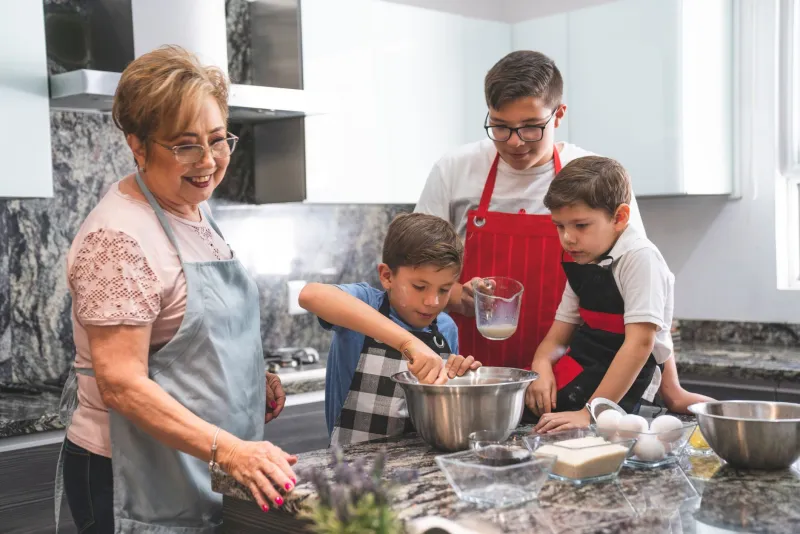
The Hartleys are not unusual in having a sweet-making tradition, though they might be unusual in how seriously they take it. Every year in the first week of December, four generations gather at Diane's house in Bakewell. Her husband's mother, now 91 and no longer able to stand for long, sits in a chair near the worktop and offers commentary. Diane's daughter and two grandchildren do the physical work. The recipe hasn't changed in decades.
What they make — peppermint creams, tablet, and a coconut ice that the family calls "pink stuff" — takes most of a Saturday afternoon. The results get distributed across the family at Christmas. The process is, by all accounts, chaotic, occasionally argumentative, and absolutely non-negotiable.
"We've had Christmases where we couldn't all be together," Diane says. "But we've never missed the sweet-making. Even during the pandemic we did it over video call. My daughter held her phone up to the pan so Gran could see the tablet setting. She cried. We all did a bit."
More Than Just a Recipe
There's something quietly countercultural about families who make sweets by hand. Not in any grand ideological sense — nobody's making a political statement by pulling toffee on a Sunday afternoon. But in a food landscape dominated by convenience, the deliberate choice to spend hours on something you could buy for a few quid at a supermarket says something about what the act of making is actually for.
For the Okafor family in South London, sweet-making is layered with a different kind of meaning. Sandra Okafor, 52, grew up in Nigeria and learned to make a palm sugar brittle from her grandmother. When she moved to the UK in her twenties, she found that the ingredients were harder to source but the technique translated surprisingly well to British treacle toffee.
"I started making them together — my grandmother's brittle and the toffee I learned from my neighbour in Lewisham," she says. "My kids grew up eating both. Now they make both. That's our family's confectionery. It doesn't exist anywhere else."
Her eldest son, Kofi, 26, describes the annual toffee session as one of the few occasions when three generations genuinely talk to each other without anyone looking at their phone.
"There's something about having your hands busy that makes conversation easier. You're not staring at each other across a table. You're both watching the pan. It's easier to say things."
The Recipes That Nearly Didn't Survive
Not every family tradition has a neat origin story. For the McAllisters in Ayrshire, their tablet recipe nearly disappeared entirely when the family member who held it — a great-aunt called Morag — died without writing it down.
"We spent about three years trying to reconstruct it from memory," says Fiona McAllister, 44. "My mum remembered the texture. My cousin remembered the flavour. We both remembered the colour but couldn't agree on it. We made batch after batch trying to get back to something that tasted right."
The process of reconstruction became its own tradition. The McAllisters now make tablet twice a year: once at Christmas with the version they eventually settled on, and once in summer with experimental variations. The summer batch is judged by anyone who can remember Morag's original.
"We've never quite matched it. But trying has become the point," Fiona says.
What Gets Passed Down
It would be easy to frame these stories as purely nostalgic — families clinging to the past in the face of an impersonal, mass-produced present. But spend any time with the families involved and a different picture emerges. The traditions are alive, not preserved.
Kofi Okafor has started experimenting with flavour combinations his mother never tried, adding cardamom to the toffee and occasionally substituting golden syrup for treacle. Sandra watches with something between suspicion and delight.
"She pretends to disapprove," Kofi laughs. "But she always tries it."
Diane Hartley's youngest grandchild, aged nine, has already declared that he wants to be in charge of the peppermint creams when he's older. He has started making his own notes in the margins of the notebook — in pencil, because Diane won't let him use pen yet.
"He asked me why we make them ourselves when we could just buy them," Diane says. "I told him: because nobody else's taste the same. He seemed satisfied with that."
He should be. Nobody else's do.