The Blueprint in the Window: What Every Great British Sweet Shop Owes to Piccadilly
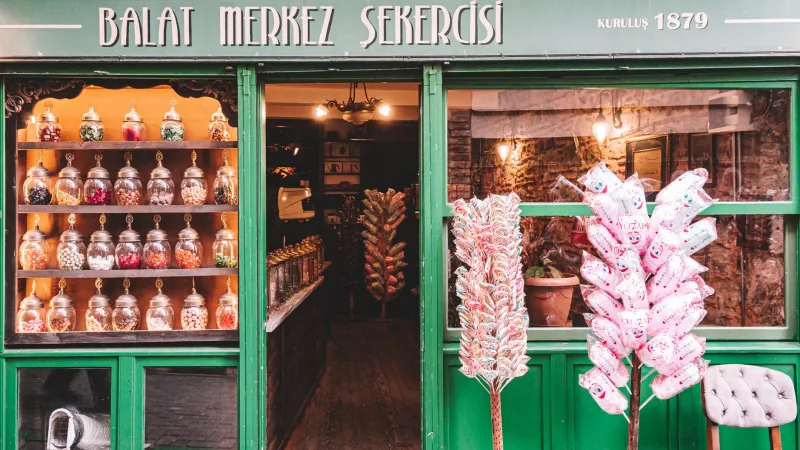
There's a sweet shop in a market town in Shropshire — the kind of place with a handwritten chalkboard outside and jars arranged in rows behind a mahogany counter — that the owner will tell you has looked this way since his grandfather's time. He's proud of its independence. Its local character. The fact that it owes nothing to fashion or trend.
He is, in the most affectionate sense possible, completely wrong.
The layout of his shop, the logic of its display, the very instinct to put the boiled sweets at eye level and the novelty items near the door — all of it traces back, through a chain of imitation and influence that spans well over a century, to the confectionery culture that crystallised around one specific stretch of London: Piccadilly.
What Piccadilly Actually Was
To understand why Piccadilly became the template for British sweet retail, you have to understand what it represented at its peak. By the late Victorian era, the Piccadilly area — encompassing the great arcade, the surrounding streets, and the establishments that lined them — had become the most concentrated expression of retail ambition in the country.
This wasn't just about wealth, though there was plenty of that. It was about the idea that shopping could be an experience rather than a transaction. The arcade itself, built in 1819, was among the first purpose-designed retail environments in Britain — a covered, lit, curated space where the act of browsing was as much the point as the act of buying.
Confectioners in and around Piccadilly absorbed this philosophy early. They understood that presentation was inseparable from product. The way a sweet was displayed — the jar it sat in, the light that fell on it, the proximity to other sweets that made it seem more desirable by contrast — was part of what you were selling.
"What you're looking at in the great Piccadilly confectioners of the late nineteenth century is essentially the invention of modern sweet shop retail," says Dr. Harriet Lowe, an architectural historian at University College London who has written about the development of British retail spaces. "These weren't just shops. They were carefully designed environments intended to produce a specific emotional response. And that response — delight, abundance, the sense of being somewhere special — is exactly what every good sweet shop has been trying to reproduce ever since."
The Elements of the Formula
So what, precisely, is the Piccadilly formula? It's worth being specific, because the elements are more deliberate than they might appear.
First, there is the question of visibility. The great Piccadilly confectioners understood that their product needed to be seen — not packaged and hidden, but displayed openly, in quantity, in a way that communicated abundance. Glass jars, arranged in rows or tiers, achieved this perfectly. The visual effect of fifty jars of differently coloured sweets is genuinely arresting. It signals generosity and variety in a single glance.
Second, there is the counter as theatre. In the best traditional sweet shops — and this goes back directly to the Piccadilly model — the counter isn't a barrier between customer and product. It's a stage. The ritual of pointing, selecting, weighing, and bagging is a performance that both parties participate in. It slows the transaction down deliberately, turning a purchase into an event.
"The weighing of sweets is genuinely important," says retail design consultant Fiona Abara, who has worked with independent sweet shops across the UK. "It creates anticipation. It makes the customer feel that what they're receiving has been prepared specifically for them. You can't replicate that with a pre-packaged bag, no matter how nice the packaging is."
Third — and this is perhaps the subtlest element — there is the management of scarcity within abundance. The great Piccadilly confectioners were expert at making their shops feel simultaneously generous and exclusive. Certain sweets were displayed prominently; others were kept in reserve, available only to those who knew to ask. Seasonal and limited items created urgency. The sense that you might not be able to get exactly what you wanted was, paradoxically, part of the appeal.
How the Template Spread
The mechanism by which this formula spread across Britain is less dramatic than you might expect. There was no manifesto, no trade organisation handing out guidelines. It spread the way most cultural templates spread: through imitation, aspiration, and the simple logic that what works in one place tends to work in another.
Confectioners from across Britain visited London — for business, for pleasure, for the annual trade shows that brought the industry together. They walked through Piccadilly. They noted what they saw. They went home and, consciously or not, applied what they'd learned.
Trade journals of the late Victorian and Edwardian periods frequently featured photographs and descriptions of London's leading confectionery establishments, with a clear implication that these were the standards to which provincial retailers should aspire. The Piccadilly aesthetic — the jars, the counter, the theatre of the transaction — was held up, repeatedly and explicitly, as the model.
"There's a 1903 issue of a confectionery trade publication I came across during my research," says Dr. Lowe, "that essentially tells its readers: if you want to know how to display your sweets, go to Piccadilly and look. The influence was acknowledged openly at the time. We've just forgotten about it."
What Modern Retailers Can Learn
For today's sweet shop owners, the lessons of the Piccadilly model are arguably more relevant than ever. In an era when almost anything can be ordered online and delivered the next day, the physical sweet shop needs to justify its existence through experience — and experience is precisely what the Piccadilly formula was always about.
Fiona Abara works with independent retailers who are trying to navigate exactly this challenge. Her advice tends to circle back to the same principles. "Make the shop worth visiting. Give people something to look at, something to do, something to feel. The jar display isn't just tradition — it's a genuine competitive advantage over e-commerce, because it creates a sensory experience you can't replicate on a screen."
The counter ritual matters too. In an age of self-service and automated checkouts, the sweet shop that still weighs your quarter of pear drops and twists the bag shut is offering something genuinely rare: a transaction that treats you as an individual rather than a unit.
"People are hungry for that," says Fiona. "They don't always know how to articulate it, but they feel it. The sweet shops that are thriving right now are almost all doing some version of the traditional model. It's not nostalgia — it's just good retail."
The Enduring Influence
Back in Shropshire, the shop owner is listening to all of this with an expression that mixes mild scepticism with something that might be quiet pride.
"So you're saying my grandfather was copying London?" he asks.
Not exactly. What his grandfather was doing — what every confectioner who ever arranged jars in a window and stood behind a counter with a brass scoop was doing — was participating in a tradition that Piccadilly helped shape but never owned. A tradition of making the ordinary act of buying sweets feel, just for a moment, like something special.
That instinct didn't originate in one place. But it was refined there, and distributed from there, and it persists because it works. Walk into almost any sweet shop in Britain that still feels right — that still makes you want to linger, to point, to take your time — and you're standing in the long shadow of Piccadilly.
You just can't always see it from where you're standing.