From Ration Books to Pick 'n' Mix: The Sweets That Marked Every Chapter of British Life

Photo by Photo by Jason on Unsplash on Unsplash
Ask someone about their favourite sweet from childhood and watch what happens. Their eyes go a little distant. A smile creeps in before they've even said a word. Then comes the name — a Rhubarb and Custard, a Blackjack, a Sherbet Fountain — spoken with the kind of reverence usually reserved for much grander things.
That's the strange power of British confectionery. It doesn't just taste of sugar. It tastes of time.
At Piccadilly Sweets, we're in the business of keeping those flavours alive. But we're also endlessly curious about why they matter so much — and how they've changed across the decades while somehow staying exactly the same.
The Fifties: Sweetness After the Storm
For anyone growing up in postwar Britain, sweets weren't a given. Sugar rationing, which had been in place since 1942, wasn't lifted until February 1953 — and what followed was, by all accounts, something close to chaos. Children descended on corner shops. Stocks ran out within days. The government briefly reintroduced rationing before finally letting go for good in September of that year.
Margaret Hollis, now 81, grew up in Sheffield and remembers the moment vividly. "We'd been allowed two ounces a week," she tells us. "When rationing ended, my mum gave me a whole shilling and told me to go and choose whatever I liked. I stood in that shop for what felt like hours. I didn't know how to choose. I'd never had to."
The sweets of that era were modest by today's standards — pear drops, acid drops, aniseed balls, toffees wrapped in wax paper. But their significance was enormous. They represented freedom, abundance, and the slow exhale of a country learning to enjoy itself again.
The Sixties and Seventies: The Golden Age of the Corner Shop
If the fifties were about relief, the sixties and seventies were about discovery. New sweets arrived at pace. Cadbury, Rowntree's, and Bassett's were expanding their ranges. The corner shop — that glorious, slightly chaotic institution — became the social hub of childhood.
This was the era of the quarter bag. You'd point at something behind the glass, the shopkeeper would weigh it out, twist the paper bag shut, and hand it over. There was ritual in it. There was theatre.
"We'd pool our pocket money," recalls David Okafor, 58, who grew up in Brixton. "Someone would have 5p, someone else would have 3p, and we'd negotiate what we were getting before we even got to the shop. Refreshers, Cola Bottles, Flying Saucers — it was very serious business."
Sweets like Parma Violets, Fruit Salads, and Chewits became generational shorthand. If you know, you know.
The Eighties: Brash, Bold, and Brilliant
The eighties brought neon colours, novelty formats, and sweets that seemed almost designed to alarm parents. Fizzy belts. Tongue-painting lollies. Things that turned your mouth blue and made no apology for it.
But alongside the new arrivals, the classics held their ground. Werther's Originals launched in the UK in 1981 and immediately became associated with grandparents — a reputation they've never quite shaken, though we mean that entirely affectionately. Liquorice allsorts remained a fixture in every tin passed around at Christmas. Some things, it turned out, were simply unshakeable.
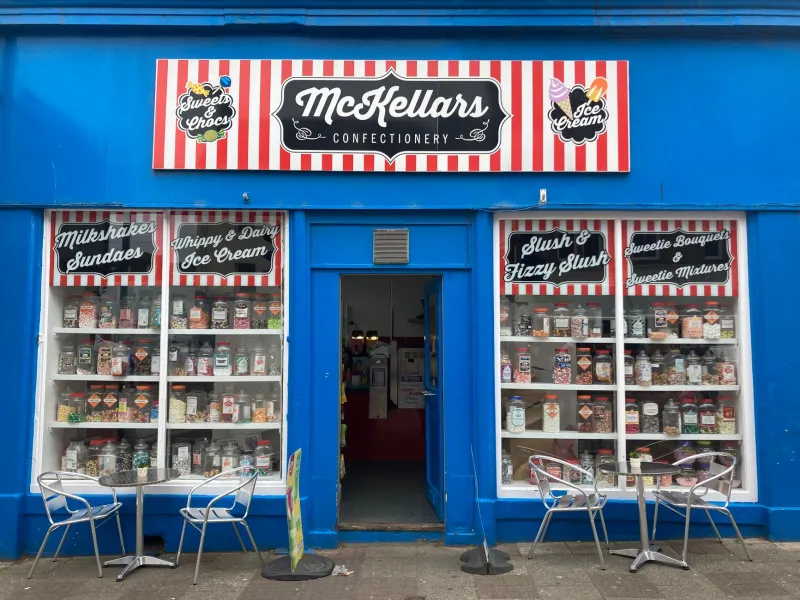
The pick 'n' mix counter, meanwhile, reached its cultural peak. Woolworths became a pilgrimage site. The combination of tongs, plastic bags, and an overwhelming wall of options felt genuinely exciting — even slightly transgressive, in the way that only the very best childhood experiences do.
The Nineties and Beyond: Nostalgia Becomes an Industry
By the time the nineties arrived, something interesting was happening. People who had grown up with those corner shop sweets were now adults with disposable income — and they wanted their favourites back.
Retro sweet hampers started appearing. Online sweet shops began curating "childhood classics." The language around confectionery shifted: words like heritage, traditional, and artisan started cropping up on packaging.
This is, in many ways, the world Piccadilly Sweets was built for. There's genuine appetite — forgive the pun — for sweets that carry history in every chew. Not because people are living in the past, but because those flavours connect us to something real.
What the Makers Say
We spoke to a third-generation confectioner in the West Midlands who has been making boiled sweets using the same pulled-sugar technique his grandfather used in the 1940s. He asked not to be named — "I don't want the fuss" — but he was generous with his thoughts.
"People think nostalgia is about sweetness," he said, carefully turning a rope of hot sugar on the pulling hooks. "But it's not. It's about familiarity. When someone bites into one of our pear drops and it tastes exactly like they remember, that's not an accident. That's forty years of not changing a single thing."
He paused. "Which drives my accountant absolutely mad, but there you go."
That commitment to consistency — to doing the same thing, the right way, decade after decade — is what separates truly beloved sweets from merely popular ones. Trends come and go. Salted caramel everything, ruby chocolate, single-origin this and that. But a good sherbet lemon doesn't need rebranding.
The Sweet That Finds You
There's a lovely thing that happens when people visit us at Piccadilly Sweets. They'll be browsing, perfectly composed adults going about their day, and then they'll spot something — a jar of Kola Kubes, a bag of Sweet Peanuts, a twist of Barley Sugar — and something shifts. They'll pick it up and say, almost to themselves, I haven't had one of these in years.
And then they're gone. Not physically — they're still standing right there. But somewhere else too. Somewhere with a school uniform and a 10p piece and a very important decision to make.
That's what British confectionery does. It doesn't just satisfy a craving. It opens a door.
And honestly? We wouldn't have it any other way.