The Secret Language of Taste: How Old-School Confectioners Build Flavour From Nothing But Instinct
Pick up a well-made humbug and really think about it for a moment. There's the immediate hit of peppermint, sharp and clean. Then something slightly warmer underneath — almost herbal, faintly sweet in a way that lingers differently from the sugar itself. And then, just as you think you've got the measure of it, a faint cooling sensation that wasn't there at the start. That's not an accident. That's craft.
The British sweet, at its best, is a study in flavour architecture. And the people who build those flavours — the handful of heritage confectioners still working from original methods in small workshops across the country — are doing something genuinely extraordinary without a single piece of modern technology to assist them.
More Than Just Sugar and Essence
Ask most people how a boiled sweet gets its flavour and they'll say something like: "You add peppermint oil, don't you?" And yes, technically, that's part of it. But reducing the process to a single addition is a bit like saying a good beef stew is just meat and water. The reality is considerably more layered.
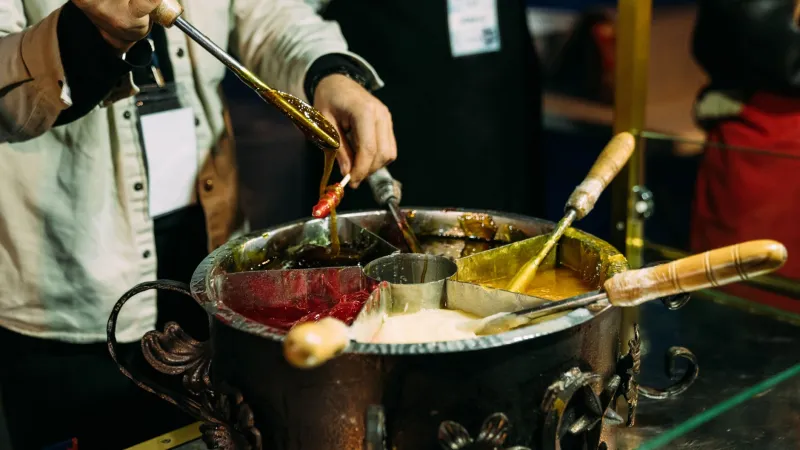
Marjorie Tillett has been making sweets in her family's Derbyshire workshop for thirty-one years. She's the third generation of Tilletts to work the copper pans, and she's quietly emphatic on this point. "People think flavour is something you drop in at the end," she says, wiping her hands on her apron. "But you're building it from the moment the sugar hits the heat. The temperature you cook to, the speed you work the mass, even the humidity in the room — all of it contributes to the final taste profile."
What Marjorie is describing is flavour layering: the deliberate, sequential introduction of different taste compounds at different stages of the confectionery-making process, so that they interact, modify one another, and create something richer than any single ingredient could produce alone.
The Role of Heat — and Timing
Sugar itself transforms as it cooks. At different temperatures, it produces different flavour compounds through a process called the Maillard reaction and, at higher heats, caramelisation. A confectioner who pulls their sugar at 140°C is working with a subtly different base than one who takes it to 150°C, even if both would describe the result as a "hard boiled sweet."
This is where the first layer of flavour complexity enters — before a single drop of essence is added. Heritage confectioners know their sugar by sight and smell. They know what colour the mass should be, how it should move, what it should smell like at each stage. No probe required.
Geoffrey Marsh, who runs a small operation in York producing traditional Yorkshire mixture sweets, explains it simply: "Modern producers often use glucose syrups and precise automated cooking to get consistency. Fair enough. But you lose the variation in the base, and that variation is where character lives. Two batches of my aniseed drops will never be identical — and that's not a flaw, that's the point."
Essences, Oils, and the Art of Blending
Once the sugar base is established, the real alchemy begins. Traditional British confectionery relies on a combination of essential oils, botanical extracts, and food-grade acids — but not all at once, and not without considerable thought about how they'll interact.
Peppermint oil, for example, contains menthol but also a range of secondary compounds including menthone and limonene. These behave differently at different temperatures. Add the oil too early and the volatile top notes cook off, leaving something flat and one-dimensional. Add it too late and it sits on the surface of the sweet rather than integrating into the body. The window is narrow, and it takes years to feel it reliably.
"I use three different peppermint sources for my mints," says Marjorie. "One is sharper, one is softer, one has a slightly eucalyptus quality. None of them alone gives me what I want. But together, in the right proportions, added at slightly different moments — that's when it starts to taste like something real."
Acids play an equally important role. Citric acid, tartaric acid, and malic acid each have distinct profiles: citric is bright and immediate; tartaric is rounder and slightly more complex; malic is the one you'd associate with green apple, with a slower, more lingering sourness. Layering these acids — sometimes in the sweet itself, sometimes as a surface dusting — creates the kind of sourness that evolves as you eat, rather than just hitting you once and fading.
Why Modern Shortcuts Fall Short
The food industry has, of course, developed synthetic flavour compounds capable of mimicking individual taste notes with impressive accuracy. You can buy a compound labelled "strawberry" that hits the right olfactory receptors convincingly enough. So why do so many mass-produced sweets still taste somehow thin? Why does a supermarket strawberry lace taste nothing like the strawberry drops from a proper sweet shop?
Geoffrey has a theory. "Synthetic compounds are built to replicate a single flavour hit. But real flavour isn't a single hit — it's a sequence. It develops over time in your mouth. The moment you bite down is different from thirty seconds later, which is different again from the aftertaste. That sequence is what makes something taste real, and you can't fake the sequence easily."
Marjorie is more blunt: "They're optimising for cost and shelf life, not taste. Which I understand — they're a different kind of business. But it means they're always going to be working backwards from a target, rather than building something from scratch."
Passed Down, Not Written Down
Perhaps the most striking thing about talking to heritage confectioners is how little of their knowledge exists in written form. Recipes are recorded, of course — ingredients, quantities, basic temperatures. But the actual technique, the feel of when to pull the sugar, the instinct for how a particular batch of oil is behaving differently from the last, the ability to taste a work-in-progress and know what it still needs — that's transmitted person to person, in the workshop, over years.
It's knowledge that doesn't survive if the chain breaks. And in British confectionery, that chain has broken in more places than most people realise. Whole categories of sweet — certain regional specialities, particular flavour combinations that were once common — have effectively vanished because the last person who knew how to make them properly is no longer around to teach anyone.
Which is, perhaps, the most compelling argument for seeking out traditional British sweets made by people who actually know what they're doing. Not just for the taste — though the taste is genuinely different — but because every bag you buy from a heritage confectioner is a small act of cultural preservation.
Tasting It for Yourself
The next time you're working your way through a quarter of proper boiled sweets, take a moment to pay attention. Notice whether the flavour changes as the sweet diminishes. Notice whether there's a point where something new emerges — a warmth, a sharpness, a faint floral note you didn't catch at first. If there is, you're tasting the work of someone who understands flavour as a journey rather than a destination.
That's the sweet alchemy that no shortcut has ever quite managed to replicate. And it's alive and well, if you know where to look.